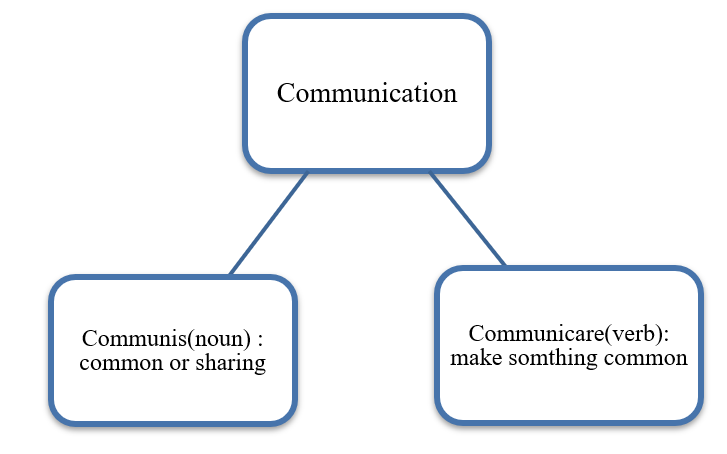
Communication can be defined as the imparting or exchanging of information by speaking, writing or using some other medium. The word ‘communication’ has its origin from the Latin words ‘Communis’ and ‘Communicare’.
PROCESS OF COMMUNICATION:
· Sender: Sender is the person who sends the message. The message may be a thought, idea, symbol, a picture report, order, postures and gestures, even a momentary smile. The sender is the creator of the message.
· Encoding: Encoding is transforming the message into an appropriate medium which may be verbal or non-verbal depending upon the situation, space, time, and nature of the message to be sent to the intended receiver. The sender encodes the message into a series of words, symbols, or pictures.
· Message: It is the information the sender needs to convey to the receiver. The data transmitted by words as in speech and write-ups, pictures, signs, or symbols are depending upon the situation.
.png)
· Channel: Channel refers to the media or medium through which the message is transmitted. The message may be written or oral, and it may be sent via a computer, telephone, cell phone, apps or televisions etc
· Decoding: Decoding refers to interpreting or comprehending the sent message. The receiver interprets the message and tries to understand it in the best possible manner.
· Receiver: Receiver is the person or group of person who is receiving the message. He is at the other end of the process. He may be a listener, viewer, or reader. He needs to decode the message sent in the best possible manner such that the real intent of the communication is attained.
· Feedback: It is the reply given by the receiver after reading the message. It is necessary to ensure that the message has been correctly decoded and comprehended the way it was sent. Feedback in communication process is the response that gives us some indication of how effectively we communicate.
In short, the process of communication can be defined as:
· The sender has an idea/information.
· Sender encodes the idea in words, symbols.
· The sender transmits the message through the medium/channel.
· The receiver receives the message and decodes it.
· The receiver sends feedback to the sender.
TYPES OF NOISE
In any communication system, during the transmission of the signal, or while receiving the signal, some unwanted signal gets introduced into the communication, making it unpleasant for the receiver, questioning the quality of the communication. Such a disturbance is called as Noise.
.png)
· Physical noise: Physical noise is interference that is external to both speaker and listener; it hampers the physical transmission of the signal or message. Examples loud party at the neighbors while you’re trying to record, loud kids who don’t want to take their nap, irritating hum of your computer, air conditioner, or heater.
· Physiological Noise: Barriers within the sender or receiver create physiological noise. Examples of physiological noise on the podcaster’s side: articulation problems, mumbling, talking too fast, talking too slow, forgetting to pause, forgetting to breathe. An example of physiological noise on the listener’s side: hearing problems. Maybe the listener can’t hear high tones as clearly as they used to. For some, low tones are the problem. Their difficulty in literally hearing words and sounds becomes physiological noise.
· Psychological Noise: Psychological noise is mental interference in the speaker or listener. Three examples of psychological noise are wandering thoughts, preconceived ideas, and sarcasm.
· Semantic Noise: Semantic noise is interference created when the speaker and listener have different meaning systems. Maybe when I use a word, you have a slightly different meaning in mind. This can cause confusion.
TYPE OF COMMUNICATION
1. Based on the medium employed
Ø Verbal Communication: It means communicating with words, written or spoken. Verbal communication consists of speaking, listening, writing, reading, and thinking. It may further be classified as Oral or Written Communication.
Ø
.png)
2. Based on whom the message is addressed
We classify communication according to the number of persons (receivers) to whom the message is addressed:
.png)
3. Classification of communication on the basis of direction
· Horizontal or lateral communication: When communication takes place between two or more persons whom are subordinates working under the same person or those who are working on the same level, it is called lateral or horizontal communication.
· Vertical communication: Communication takes place between two or more persons who are in different rank. One of whom will be a superior in hierarchy within the same department.
· Upward communication: The communication that flows from bottom to top, which is from a lower hierarchical level to a higher level, is called Upward Communication. The main function of upward communication is to supply information to the upper levels about what is happening at the lower levels.
· Downward Communication: The communication that flows from top to bottom is known as downward communication. Any organization has an inbuilt hierarchical system, and in that, in the ï¬rst instance, communication invariably flows downwards.
· Diagonal Communication or Crosswise communication: Diagonal or Crosswise communication includes the flow of information among persons at different levels who have no direct reporting relationships or it take place between persons of different rank from different organizations or department.
4. Formal and informal communication
Formal Communication:
A formal channel of communication can be deï¬ned as a means of communication that is formally controlled by managers or people occupying positions in an organization. The communication flows through formal channels, that is, officially recognized positions along the line in the organization. This ensures that the information flows orderly, timely, and accurately. Any information, decision, memo, reminder etc. will follow this path.
Six types of formal communication networks:
· Chain Network: Under chain network, the information and message flows only up and down in a hierarchical chain of command. In other words, the chain network rigidly follows the formal chain of command in the organization.
· Wheel Network: Under the wheel network, the information and message flows among the group members through a leader, that is, the central point. In other words, the group members do not communicate with each other directly but rely on the leader to act as the central conduit. It is the most centralized type of formal communication network.
· Circle network: Under circle network, the group members interact with the adjoining members only. In other words, the information and message is transmitted laterally among the group members.
· All-channel network/Star network: Under the all-channel network, all the members of a group actively communicate with each other freely. It is the most decentralized type of formal communication network. It is also known as the ‘completely connected’ network.
· Inverted V network: Under the inverted V network, a sub-ordinate communicates with his immediate superior as well as second superior (superior’s superior). However the matters on which information and message can be sent in the second case are specified.
.png)
Informal Communication or Grapevine Communication:
Side by side with the formal channel of communication, every organization has an equally effective channel of communication that is the informal channel. It is not officially sanctioned, and quite often it is even discouraged or looked down upon. However, then, it is very much there and has been given the name ‘grapevine’ precisely because it runs in all directions-horizontal, vertical, diagonal.
Keith Davis has investigated the phenomena of grapevine (informal communication) in organizations. There are four types of informal networks:
· Single strand network : Under the single strand network, the information passes from one to one, that is, one member communicates to another member who in turn communicates to another member and so on.
· Gossip network: Under the gossip network, the member communicates non-selectively, that is, a member having information passes it on to everyone he meets.
· Probability network : Under the probability network, information passes according to the law of probability, that is, one member communicates with others randomly, who in turn communicate to some others. Selective in nature.
· Cluster network :Under the cluster network, the information passes selectively, that is one member communicates with only those members whom he trusts and they in turn pass it on to some other selected members. According to Keith Davis, the cluster type is the most popular and widely prevalent.
.png)
· Synchronous communication happens when messages can only be exchanged in real time. It requires that the transmitter and receiver are present in the same time and/or space. Examples of synchronous communication are phone calls, chat rooms, video conferencing.
· Asynchronous communication happens when information can be exchanged independent of time. It doesn’t require the recipient’s immediate attention, allowing them to respond to the message at their convenience. Examples of asynchronous communication are emails, online forums, letters etc.
PUSH & PULL COMMUNICATION
Push communication and pull communication are two different methods of communication that are commonly used in various contexts, including technology, marketing, and business. Push communication is a method of communication where information is sent or pushed to a recipient, whether they have requested it or not. For example, an email newsletter or a push notification on a mobile app is a form of push communication. The sender takes the initiative to send information without waiting for the recipient's request. On the other hand, pull communication is a method of communication where the recipient requests or pulls information from a sender or source. For example, searching for information on a search engine or accessing a website for a specific purpose is a form of pull communication. The recipient takes the initiative to request the information they need.
BARRIERS AND PROBLEMS
· Semantic Barriers: Concerned with language difficulties. These occur due to the differences in the individual interpretations of words and symbols used in the process of communication.
· Ideological Barriers: The members of the organization do not share the same ideological perspectives and orientation. This affects the effective communication process.
· Filtering: It refers to the sender’s purposeful and deliberate manipulation of information to be passed on to the receiver.
· Dogmatism: Attitudes, opinions and beliefs possessed by a person prevents him from accepting accurate and additional information as it conflicts with the current situation.
· Halo effect: The tendency to draw a positive general impression about an individual based on a single characteristic.
· Horns effect: The tendency to draw a negative general impression about an individual based on a single characteristic.
· Selective perception: The tendency to choose to interpret what one sees based on one’s interests, back-ground, experience and attitudes.
· Contrast effect: Evaluation of a person’s characteristics that is affected by comparisons with other people recently encountered who rank higher or lower on the same characteristics.
· Stereotyping: Judging someone based on one’s perception of the group to which that person belongs
· Self-fulfilling prophecy: A situation in which a person inaccurately perceives a second person and the resulting expectations cause the second person to behave in ways consistent with the original perception
· Anchoring bias: A tendency to fixate on initial information from which one then fails to adjust adequately for subsequent information
· Confirmation bias: The tendency to seek out information that reaffirms past choices and to discount information that contradicts past judgments
· Availability bias: The tendency for people to base their judgments on information that is readily available to them
· Escalation of commitment: An increased commitment to a previous decision despite negative information
· Randomness error: The tendency of individuals to believe that they can predict the outcome of random events
· Hindsight bias: The tendency to believe falsely, after an outcome of an event is actually known, that one would have accurately predicted that outcome
· Frame of reference/Self-image: People establish their point of view and interpret messages in accordance with their self-concepts
· Filtering: A sender’s manipulation of information to be more favourable by the receiver
· Perpetual bias: It prevents us to look at reality in a truthful manner. The most common perpetual biases include Stereotyping and self-fulfilling prophecies
The four barriers of intercultural communication include: Ethnocentrism, Stereotyping, Prejudice and discrimination
Ethnocentrism v/s Cultural Relativism
Ethnocentrism: My culture is the best in every way. It is the idea that one’s own culture is the main standard by which other cultures may be measured
Cultural Relativism: Every culture is equally valid, so you have no right to impose your culture’s values on other cultures. This concept covers a wide area of human interactions, beliefs, values and practices
Conservatism lean towards ethnocentrism, while liberals lean towards cultural relativism. Most people dwell between these extremes.
Stereotyping: It emerges from ego, it becomes a barrier to communication when people act as if they already know the message that is coming from the sender, as if no message is necessary. In stereotyping we assume that a person belonging to a certain group will display specific characteristics. However, the person may not actually exhibit those characteristics.
7 C’s OF COMMUNICATION (Teaching perspective)
.png)
4 S’ of Effective Communication
· Shortness
· Strength
· Sincerity
· Simplicity
TYPES OF LISTENING
When we engage in listening we are doing so for many different reasons depending upon the goals in which we are trying to achieve.
Active listening: It involves holding eye contact, nodding, having good posture, and mirroring the speaker’s body language to show genuine interest in what they're saying. In addition to these nonverbal cues, you must also allow the speaker to finish their thought in its entirety. Here you are fully participating in process and you will get full idea.
Passive listening: Passive listening is listening without reacting: allowing someone to speak, without interrupting. Not doing anything else at the same time, and yet not really paying attention to what's being said.
Reflective listening: This type of listening is an example of listening where you listen as well as reflect on the thoughts and ideas convey by the person.
Discriminative listening: This type of listening is the most basic type of listening. This type of listening is formed during the early years of the life of a child. A child starts learning discriminative listening in the womb of his mother. Discriminative listening can be defined as a type of listening where the listener differentiates between the two sounds produced even though he does not understand the meaning of the phrases or words.
Appreciative Listening: When you listen for appreciation you are listening for enjoyment. Think about the music you listen to. You usually listen to music because you enjoy it. The same can be said for appreciative listening when someone is speaking. Some common types of appreciative listening can be found in sermons from places of worship, from a motivational speech by people we respect or hold in high regard, or even from a standup comedian who makes us laugh.
Empathic Listening: When you listen empathically you are doing so to show mutual concern. During this type of listening you are trying to identify with the speaker by understanding the situation in which he/she is discussing. You are stepping into the other’s shoes to get a better understanding of what it is he/she is talking about. Usually during this type of listening you want to be fully present in the moment or mindfully listening to what the speaker is saying. Your goal during this time is to focus on the speaker, not on yourself. You are trying to understand from the speaker’s perspective.
Comprehensive Listening: If you are watching the news, listening to a lecture, or getting directions from someone, you are listening to understand or listening to comprehend the message that is being sent. This process is active. In class, you should be focused, possibly taking notes of the speaker’s main ideas. Identifying the structure of the speech and evaluating the supports he/she offers as evidence. This is one of the more difficult types of listening because it requires you to not only concentrate but to actively participate in the process. The more you practice listening to comprehend, the stronger listener you become.
Critical Listening: This type of listening is the opposite of informational listening. In this type of listening, a listener not only listens but also critically analyzes and evaluates what is being said. The critical listening is the most active type of listening.
Informational Listening: Informational listening is a type of listening that students do when they are in a classroom. It is a listening where the listener listens to verbal as well as non-verbal message to learn them. This type of listening can also be referred to as goal-oriented listening. A person takes notes while listening is an example of informational listening because that person postpones the processing and critical thinking of the information and just focus on grabbing the information.
COMMUNICATION MODELS
A Communication model depicts the idea of the communication process in a simpler way through diagrams, pictorial representations etc.
Major Communication Models:
1. Aristotle Model of Communication
2. Berlo’s Model of Communication
3. Shannon and Weaver Model of Communication
4. Schramm’s Model of Communication
5. Westley Model of Communication
6. Alex fish’s communication model
1. Aristotle Model of Communication
· According to this model, the speaker plays a key role in communication. He is the one who takes complete charge of the communication. The sender first prepares a content which he does by carefully putting his thoughts in words with an objective of influencing the listeners or the recipients who would then respond in the senders desired way.
· Linear model of oral communication
· Speaker centered model
· The audience is passive and this makes the communication process one way, from speaker to receiver.
.png)
2. Berlo’s Model of Communication
.png)
· David Berlo has postulated the Sender-Message-Channel-Receiver (SMCR) model of communication in 1960.
· Berlo’s Model of Communication takes into account the emotional aspects of the message. It operates on the SMCR (sender, message, channel and receiver) model. Initially it was S-R (sender, receiver) model, later extended to SMCR model. It is also a linear model where there is no concept of feedback.
· Berlo has described factors affecting the individual components in the communication.
· The model also focuses on encoding and decoding.
3. Shannon & Weaver Model for Communication (1949)
· The Shannon and Weaver Model represent the communication process in a linear form which involves a one-way communication from a sender transmitting a message to a receiver.
· The basic model contains six basic elements which form the general communication system according to Shannon and Weaver.
· A desired message or a sequence of messages out of a set of possible messages is selected by the information Source, also called Sender. In order to send to message over the communication channel, a transmitter changes the messages into a signal.
· The receiver can be seen as an inverse transmitter which changes the signal back to a message and hands this message over to the destination.
· The noise, created by a noise source refers to any distortions or errors in the communication process which can occur during the transmission or at one of the terminals.
.png)
· Weaver gives a simple example of human communication in order to understand the elements of the Communication Model.
· In this particular case of oral communication, Person A wants to share an idea with Person B. The brain (information source) of person A selects the desired idea (message) to transfer to person B.
· The voice mechanism (transmitter) of Person A transforms the thought into sound which is transferred through the air (channel).
· When the oral message arrives in the ear and its associated nerves of Person B, the sound can be reconstructed into the idea, so Person B received the idea. As Person A speaks to Person B in a loud surrounding (noise source), it might be that Person B cannot fully receive the sound. Or, Person B got distracted by the loud background and thus, does not listen to the incoming sound of Person A.
· Entropy: The concept of entropy describes the measure of uncertainty in a system. When the probability in choosing between two messages to send is completely free and unbiased, the entropy is large as the receiver cannot predict the incoming message because of the uncertainty. In contrast, the entropy is very small when there is no choice of different messages for the transfer.
· Redundancy: A message is highly redundant when it contains a lot of items that add no new value. These parts of the messages are unnecessary, meaning that the sense of this message would be still complete even if this fraction of message would be missing. A general understanding of redundancy in communication is important because it helps combat noise in a communicating system e.g. in repeating a message.
· Channel Capacity: The capacity of a channel is described as the ability of the system to transmit what is produced out of a source of given information.
4. Schramm’s Model of Communication
• Schramm’s Model of Communication was postulated by Wilbur Schramm in 1954.
• It is a Circular Model of Communication.
• This model was adapted from the theories of another theorist Osgood so it is also known as Osgood and Schramm Model of Communication or Encode-Decode Model of Communication.
· Information is of no use unless and until it is carefully put into words and conveyed to others.
· According to this model, encoding initiates the process of communication by converting thoughts into ideas.
· The message is actually of no use until and unless the second party is able to understand or decode the information that the sender wants to communicate.
· According to the Schramm’s Model, encoding and decoding are two essential processes of an effective communication.
· It also emphasizes that the communication is incomplete until and unless the sender receives a feedback from the recipient.
· This model breaks the traditional sender – receiver model and presents a practical process of communication.
· Schramm believed that an individual’s knowledge, experience and cultural background plays a vital role in communication.
· Semantic noise – Sender and receiver apply different meaning to the same message.
.png)
5. Westley and MacLean’s Model of Communication
· Westley and MacLean’s Model of Communication is proposed by Bruce Westley and Malcolm S. MacLean Jr. in 1957.
· As Westley and MacLean are associated with the field of Journalism studies, this model can be seen in two contexts – interpersonal and mass communication.
· Feedback is the point of difference between interpersonal and mass communication as in interpersonal communication, the feedback is direct and fast whereas in mass communication, the feedback is indirect and slow.
· Communication begins only when a person receives message from the surroundings.
· This model considers a strong relation between the signals from the surroundings and the process of communication. According to this model the process of communication begins with receiving messages rather than sending messages.
· Each receiver responds to the message they received based on their object of orientation.
.png)
· Example: A Daily News Papers will receive many Press releases from many Public Relations Agencies on behalf of their clients. In this case, News paper will publish the selected Press release due to the space constraints. Then, readers can directly respond to the client or they can respond to the News daily which published in the Newspaper. If readers responded to daily News paper, it will communicate the feedback to the concerned PR Agency. X1, X2 and X3—are Press Release, Feedback (f), Clients (A), Reader (B) and Daily News Paper (Gate Keeper) (C)
1. Feedback Loop between Reader (B) and News Paper (C) – fBC
2. Feedback Loop between News Paper(C ) and Client (A)- fCA
3. Feedback loop between Reader (B) and Client (A)- fBA
· This model accounts for Feedback.
· It can account for both Interpersonal communication and Mass communication.
· It is a predictive model of communication and very descriptive also.
· Westley and Maclean communication model is Two Dimensional.
6. Alex fish’s communication model
Alex fish divided communication models into three types:
a) Transmission/Linear Model : Transmission model describes communication as a one-way, linear process. A sender encodes a message and transmits it through a channel to a receiver who decodes it.The transmission of the message may be disrupted by noise..png)
b) Interactive Model of Communication or Convergent Model: Interactive model, also known as convergence model, deals with exchange of ideas and messages taking place both ways from sender to receiver and vice-versa. Field of Experience is a communication pattern alteration factor like culture, social, psychology, situation and channels used. Overlapping field of experiences initiates conversation and conversation, in turn, expands the communicator’s field of experience. All these factors also affect the message interpretation.
.png)
c) Transactional model of communication/ circular model: In the transactional model, communication is seen as an ongoing, circular process. The transactional model has a number of interdependent processes and components, including the encoding and decoding processes, the communicator, the message, the channel and noise. In the transactional model, communication is seen as an ongoing, circular process.The transactional model has a number of interdependent processes and components, including the encoding and decoding processes, the communicator, the message, the channel and noise.
.png)
ALBERT MEHRABIAN’S 7-38-55 RULE OF PERSONAL COMMUNICATION
The 7-38-55 rule is a concept concerning the communication of emotions. To deliver an effective communication the rule states that 7 percent of meaning is communicated through spoken word, 38 percent through tone of voice, and 55 percent through body language. Psychology professor Albert Mehrabian developed it.
.png)
MASS MEDIA – MAJOR THEORIES
1. Hypodermic or Bullet Theory
· The "Magic Bullet" theory graphically assumes that the media's message is a bullet fired from the "media gun" into the viewer's "head". Similarly, the "Hypodermic Needle Model" uses the same idea of the "shooting" paradigm. It suggests that the media injects its messages straight into the passive audience.
· This passive audience is immediately affected by these messages. The public essentially cannot escape from the media's influence, and is therefore considered a "sitting duck".
· Both models suggest that the public is vulnerable to the messages shot at them because of the limited communication tools and the studies of the media's effects on the masses at the time. It means the media explores information in such a way that it injects in the mind of audiences as bullets.
2. Two-Step Flow Theory
· The two-step flow of communication model says that most people form their opinions under the influence of opinion leaders (Opinion leadership is leadership by an active media user who interprets the meaning of media messages or content for lower-end media users), who in turn are influenced by the mass media.
· In contrast to the one-step flow of the hypodermic needle model or magic bullet theory, in two-step flow model ideas flow from mass media to opinion leaders and from them to a wider population. Opinion leaders pass on their own interpretation of information in addition to the actual media content.
.png)
3. Multi-Step Flow Theory
· The multi-step flow theory assumes that ideas flow from mass media to opinion leaders before being disseminated to a wider population. This theory was first introduced by sociologist Paul Lazarsfeld et al. in 1944.
· The multi-step flow theory also states opinion leaders are affected more by “elite media” than run-of-the-mill, mass media.
· According to the multi-step flow theory, opinion leaders intervene between the “media’s direct message and the audience’s reaction to that message.” Opinion leaders tend to have the great effect on those they are most similar to—based on personality, interests, demographics, or socio-economic factors.
· These leaders tend to influence others to change their attitudes and behaviors more quickly than conventional media because the audience is able to better identify or relate to an opinion leader than an article in a newspaper or a news program.
· This media influence theory shows that information dissemination is a social occurrence, which may explain why certain media campaigns do not alter audiences’ attitudes.
· An important factor of the multi-step flow theory is how the social influence is modified. Information is affected by the social norms of each new community group that it enters. It is also shaped by conflicting views surrounding it.
4. Cultivation Theory
· The cultivation theory suggests that people who are exposed regularly to media over long periods of time perceive the world’s social realities as presented on media and it affects the audiences’ attitudes and behaviors.
· Cultivation theory was founded by George Gerbner in the 1960s. At first, cultivation theory began as a way to test the impact that all this television viewing had on viewers, particularly with regard to violence."The primary proposition of cultivation theory states that the more time people spend 'living' in the television world, the more likely they are to believe social reality aligns with reality portrayed on television.
· The images and ideological messages transmitted through popular television media heavily influence perceptions of the real world. The more media is consumed, the more the perception of people is thought to change.
· This leads to the idea of the "Mean World Syndrome", which refers to the idea that long-term exposure of violent media will lead to a distorted view that the world seems more violent than it actually is. These images and messages, especially when repeated, create the culture that is around is. Cultivation aims at understanding how long-term exposure to TVs, with their reoccurring patterns of messages and images, can contribute to our shared assumptions about the world around us.
5. Agenda Setting Theory
· The influence of media affects the presentation of the reports and issues made in the news that affects the public mind.
· The news reports make it in a way that when a particular news report is given importance and attention than other news the audience will automatically perceive it as the most important news and information are given to them. The priorities of which news comes first and then the next are set by the media according to how people think and how much influence will it have among the audience.
· Agenda setting occurs through a cognitive process known as “accessibility”. Media provides information which is the most relevant food for thought, portraits the major issues of the society and reflects people minds.
6. The Uses and Gratification Theory
· The Uses and Gratification theory discusses the effects of the media on people. It explains how people use the media for their own need and get satisfied when their needs are fulfilled.
· In other words, it can be said that the theory argues what people do with media rather than what media does to people. Also, this theory is in contradiction to the Magic Bullet theory, which states that the audience is passive.
· This theory has a user/audience-centered approach. Even for communication, say – interpersonal, people refer to the media for the topic to discuss among themselves. By referring the media, they gain more knowledge and exposure to the world beyond their limited eyesight.
· There are several needs and gratification for people. They are categorized into five needs.
1. Cognitive needs
2. Affective needs
3. Personal Integrative needs
4. Social Integrative needs
5. Tension free needs
7. Normative Media Theory
· Media theory refers to the complex of social-political-philosophical principles which organize ideas about the relationship between media and society. Within this is a type of theory called `normative theory', which is concerned with what the media ought to be doing in society rather than what they actually do. In general, the dominant ideas about the obligations of mass media will be consistent with other values and arrangements in a given society.
· Authoritarian Theory (which applies to early pre-democratic forms of society and also to present- day undemocratic or autocratic social systems). In this view, all media and public communication are subject to the supervision of the ruling authority and expression or opinion which might undermine the established social and political order can be forbidden. Although this `theory' contravenes rights of freedom of expression, it can be invoked under extreme conditions.
· Free Press Theory (most fully developed in the United States of America, but applying elsewhere) proclaims complete freedom of public expression and of economic operation of the media and rejects any interference by government in any aspect of the press. A well- functioning market should resolve all issues of media obligation and social need.
· Social Responsibility Theory (found more in Europe and countries under European influence) is a modified version of free press theory placing greater emphasis upon the accountability of the media (especially broadcasting) to society. Media are free but they should accept obligations to serve the public good. The means of ensuring compliance with these obligations can either be through professional self-regulation or public intervention (or both).
· Development Media Theory (applying in countries at lower levels of economic development and with limited resources) takes various forms but essentially proposes that media freedom, while desirable, should be subordinated (of necessity) to the requirements of economic, social and political development.
· Alternative Media Theory. From a social critical perspective the dominant media of the established society are likely to be inadequate by definition in respect of many groups in society and too much under the control of the state and other authorities or elites. This type of theory favours media that are close to the grass-roots of society, small-scale, participative, active and non-commercial. Their role is to speak for and to the social out-groups and also to keep radical criticism alive.
· Soviet Media Theory is imitative of Leninist principles which based on the Carl Marx and Engel’s ideology. The government undertakes or controls the total media and communication to serve working classes and their interest. Theory says the state have absolute power to control any media for the benefits of people. They put end to the private ownership of the press and other media. The government media provide positive thoughts to create a strong socialized society as well as providing information, education, entertainment, motivation and mobilization. The theory describe the whole purpose of the mass media is to educate the greater masses of working class or workers. Here, the public was encouraged to give feedback which would able to create interests towards the media.
· Liberal Model in which the media operate according to the principles of the free market; without formal connections between media and politics and with minimal state intervention
· Democratic Corporatist Model is a model in which commercial media coexist with organized social and political groups and the state has a small but active role.
· Polarized Pluralist Model, with media integrated into party politics, weaker commercial media and a strong role for the state.
HOT & COOL MEDIA
· Herbert Marshall McLuhan was a Canadian philosopher whose work is among the cornerstones of the study of media theory.
· McLuhan coined the expression "the medium is the message”, the term global village, the idea of hot & cool media etc.
· Cool media are those that require high participation from users, due to their low definition (the receiver/user must fill in missing information). Since many senses may be used, they foster involvement.
· Cool media generally uses low-definition media that engages several senses less completely in that it demands a great deal of interaction on the part of the audience. Audiences then participate more because they are required to perceive the gaps in the content themselves.
o Examples: TV, phone conversations, cartoon, seminar etc.
· Cool media could be supplanted by hot media
· Conversely, hot media are low in audience participation due to their high resolution or definition.
· Hot media are ‘high definition’ because they are rich in sensory data.
· Hot media is that which engages one sense completely. Typically the content of hot media is restricted to what the source offers at that specific time.
o Examples: radio, film, print, photograph, lectures etc.